
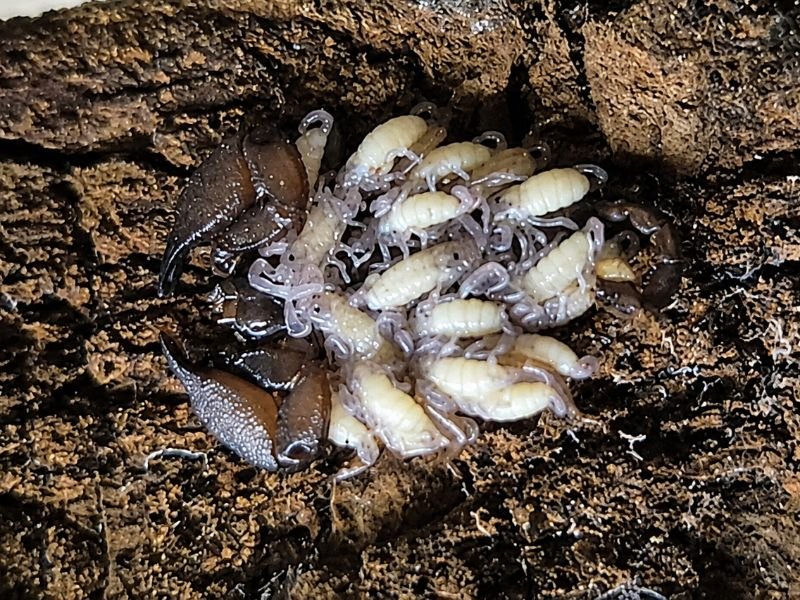
Liocheles australasiae ‘Dwarf Wood Scorpion’
£10.00
Scientific Name: Liocheles australasiae
Common Name: Dwarf Wood Scorpion
Liocheles australasiae is a small tropical scorpion with broad pincers, a flattened body and a secretive nature. This fascinating species lives beneath bark and may reproduce through parthenogenesis, allowing some females to produce young without mating.
🦂 Captive-Bred | 🌙 Nocturnal | 📏 Small Species | 🌿 Tropical Setup
Description
Scientific Name: Liocheles australasiae
Common Name: Dwarf Wood Scorpion
Sold as Scorpling.
Overview
Liocheles australasiae, commonly known as the Dwarf Wood Scorpion, is a small tropical scorpion with a flattened body. It also has broad pincers and a secretive nature.
Adults usually reach around 2.5–4 cm in length. Therefore, this species suits keepers with limited enclosure space.
Its dark brown or black body gives it a polished, armoured appearance. Meanwhile, its wide pincers create the look of a miniature prehistoric predator.
During the day, this scorpion usually hides beneath bark or decaying wood. However, it may emerge after dark to hunt and explore.
Its flattened body allows it to enter extremely narrow spaces. This shape also helps it avoid predators and changing weather conditions.
Liocheles australasiae offers plenty of interest despite its small size. Its unusual shape, feeding behaviour and reproductive biology make it especially fascinating.
Some populations can also reproduce through parthenogenesis. As a result, a mature female may produce young without mating with a male.
This species has fairly straightforward care requirements. However, it still needs stable warmth, controlled moisture and secure accommodation.
Like all true scorpions, Liocheles australasiae carries venom. Therefore, keepers should never handle it directly.
Native Habitat
Liocheles australasiae has a wide natural range. It occurs across parts of Asia, Australia and several Pacific islands.
Populations inhabit warm tropical and subtropical environments. These habitats often contain woodland, forest edges and areas with abundant decaying timber.
The Dwarf Wood Scorpion spends much of its life beneath loose tree bark. It also shelters inside rotting logs, under stones and within narrow cracks.
These enclosed spaces provide protection from predators. They also maintain stable moisture and temperature levels.
The surrounding forest floor often contains deep leaf litter and decomposing wood. Consequently, the ground remains humid without becoming permanently flooded.
Its flattened body suits this habitat perfectly. The scorpion can press tightly against wood and move through spaces that larger animals cannot enter.
A captive enclosure should reflect these natural conditions. Therefore, provide narrow hides, leaf litter and pieces of decaying hardwood.
Care
Enclosure
House Liocheles australasiae in a secure enclosure with good ventilation.
Although adults remain small, they can escape through narrow gaps. Juveniles can enter even smaller openings.
Therefore, check the lid, ventilation holes and cable openings carefully. A tightly fitting lid will prevent unexpected midnight adventures.
A small enclosure can house one adult comfortably. However, it must still provide several hiding places and a moisture gradient.
Avoid oversized enclosures for tiny juveniles. Large spaces can make feeding and monitoring much harder.
Also, keep the enclosure away from direct sunlight. Sunlight can rapidly overheat a small container.
Substrate
Provide around 3–6 cm of moisture-retentive substrate.
A suitable mixture can include:
- Coco fibre
- Organic topsoil
- Leaf mould
- Crushed rotten hardwood
- Sphagnum moss
Keep part of the substrate slightly damp. However, never allow it to become saturated or waterlogged.
A thick layer of leaf litter will help retain moisture. Furthermore, it creates extra cover and improves the natural appearance.
Springtails can help control mould and consume leftover organic material. Therefore, they make a useful addition to the enclosure.
Avoid substrates that contain fertilisers, pesticides or artificial additives.
Hides and Decoration
Provide several tight hiding places.
Flat cork bark works particularly well for this species. Press one edge into the substrate to create a narrow crevice underneath.
You can also use pieces of decaying hardwood. These materials closely recreate the scorpion’s natural shelter.
Place heavy decorations securely. Loose stones or unstable wood could shift and trap the scorpion.
The animal may spend most daylight hours hidden. This behaviour remains completely normal and does not indicate poor health.
Temperature
Maintain a temperature of approximately 24–28°C.
A small nighttime drop will not usually cause problems. However, prolonged cold conditions may reduce feeding and activity.
Heat only one side of the enclosure. This arrangement allows the scorpion to choose a comfortable temperature.
Always connect heating equipment to a reliable thermostat. A thermostat prevents dangerous temperature spikes.
Avoid placing the enclosure directly on a heat mat. Bottom heating can dry the substrate and overheat hidden animals.
Humidity
Maintain moderate to high humidity with steady airflow.
Lightly dampen one side of the substrate when necessary. Meanwhile, allow the opposite side to remain slightly drier.
This moisture gradient lets the scorpion choose suitable conditions. It also reduces the risk of stagnant, waterlogged substrate.
Do not soak the entire enclosure. Excess moisture can encourage mould, mites and harmful bacterial growth.
Juveniles can lose moisture quickly. Therefore, never allow their enclosure to dry completely.
Good ventilation remains essential. High humidity without airflow can create unhealthy conditions.
Water
Provide adults with a small, shallow water dish.
Choose a stable dish with low sides. This design allows the scorpion to enter and leave safely.
Tiny juveniles may struggle with a conventional dish. Instead, place small water droplets on the enclosure wall or damp moss.
Refresh the water regularly. Also, remove substrate and drowned feeder insects from the dish.
Feeding
Feed Liocheles australasiae with appropriately sized live invertebrates.
Suitable foods include:
- Small crickets
- Small cockroaches
- Locust hoppers
- Bean weevils
- Fruit flies
- Small mealworm pieces
Offer prey no larger than the scorpion’s main body.
Adults usually accept one small meal every 5–10 days. In contrast, growing juveniles may feed more frequently.
Remove uneaten prey within 24 hours. Crickets may attack a vulnerable scorpion during a moult.
A scorpion may refuse food before moulting. It may also hide more often and become less active.
Remove live prey when you notice these signs. Then, leave the scorpion undisturbed until its new exoskeleton hardens.
Behaviour
Liocheles australasiae has a secretive and mainly nocturnal lifestyle.
It usually hides during the day. However, it may explore the enclosure after the lights go out.
This species often uses its broad pincers to catch and restrain prey. Its body shape also helps it hunt within narrow spaces.
Individual temperaments can vary. Some specimens remain calm, while others react defensively when disturbed.
Use long feeding tongs during maintenance. For transfers, guide the scorpion into a secure catch cup.
Never handle this species directly.
Communal Keeping
Some keepers house Liocheles australasiae in small groups.
However, communal housing always carries a risk of cannibalism. Competition for food and hiding places can also cause stress.
Individual housing offers the safest option. It also makes feeding, moulting and health checks easier.
Experienced keepers may attempt group housing with enough space and multiple hides. Nevertheless, they must monitor every animal closely.
Separate individuals immediately if you notice aggression, injuries or repeated food competition.
Breeding
Liocheles australasiae has gained attention for its unusual reproductive biology.
Some populations reproduce through parthenogenesis. This process allows females to produce young without mating.
However, not every female will reproduce immediately. Age, condition, temperature and population origin may influence breeding.
Unlike insects, scorpions do not lay external eggs. Instead, the female gives birth to live scorplings.
Newborn scorplings climb onto their mother’s back. They remain there until they complete their first moult.
Avoid disturbing the female during this period. Stress may cause her to drop or consume the young.
Once the scorplings leave their mother, separate them carefully. Small individual containers make feeding and monitoring easier.
Provide each juvenile with slightly damp substrate and a small piece of bark. Also, ensure that every container has secure ventilation.
Offer tiny prey such as fruit flies or bean weevils. You can also offer small pieces of freshly killed feeder insects.
Juveniles may grow slowly. Therefore, maintain stable warmth and moisture throughout their development.
Regular feeding will support growth. However, remove uneaten prey before each moult.
Captive-Bred
Our Liocheles australasiae are captive-bred.
Captive breeding reduces demand for wild-collected scorpions. Therefore, it helps protect natural populations and their habitats.
Captive-bred animals usually adjust more easily to enclosure conditions. They also avoid many stresses linked with collection and international transport.
Each scorpion receives appropriate care before sale. However, the new keeper must prepare the enclosure before the animal arrives.
Provide suitable warmth, controlled humidity, secure hides and correctly sized live food.
With consistent care, the Dwarf Wood Scorpion makes a fascinating addition to an invertebrate collection.
Reviews
There are no reviews yet.