
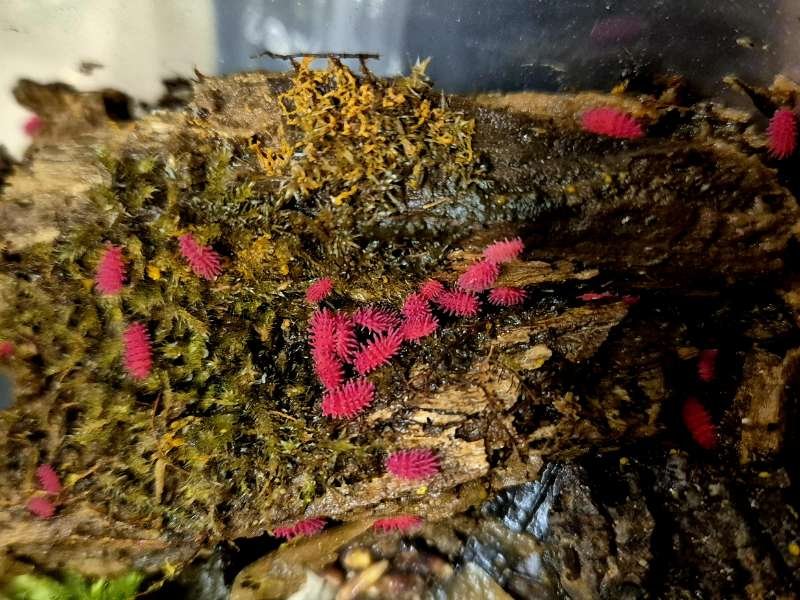
Rambutanura sp. ‘Thai Red Spiky’
Price range: £70.00 through £120.00
Scientific Name: Rambutanura sp. ‘Thai Red Spiky’
Common Name: Thai Red Spiky Springtail
Rambutanura sp. ‘Thai Red Spiky’ is a striking tropical springtail known for its vivid red colouration and distinctive spiny appearance. Additionally, it thrives in humid bioactive enclosures and makes a fascinating display species for specialist collectors.
🔴 Vibrant Red Colouration | 🪲 Unique Spiny Appearance | 🌿 Ideal for collectors
Description
Scientific Name: Rambutanura sp. ‘Thai Red Spiky’
Common Name: Thai Red Spiky Springtail
Rambutanura sp. ‘Thai Red Spiky’ is one of the most unusual and visually striking springtails available in the hobby. Unlike the small, smooth-bodied species commonly used in bioactive setups, this remarkable springtail features a bright red colouration and a heavily textured body covered in prominent spines and projections. Its extraordinary appearance has earned it a reputation as one of the most desirable specialist springtail species among collectors.
Despite its exotic appearance, this species performs many of the same ecological roles as other springtails. It helps process decaying organic matter, consumes mould and biofilm, and contributes to a healthy enclosure ecosystem. Furthermore, its bold colouration makes it far easier to observe than many traditional springtail species.
Native Habitat
Rambutanura species originate from humid tropical forests in Southeast Asia, where they inhabit leaf litter, moss, decaying wood, and other organic-rich microhabitats. These environments remain consistently warm and humid throughout the year, providing the stable conditions required for healthy colony development.
Within these habitats, they play an important role in nutrient cycling by breaking down organic waste and helping maintain healthy soil ecosystems.
Care Information
This species thrives in humid enclosures containing plenty of organic material and microhabitats.
Temperature: 20-26°C
Humidity: High humidity with good airflow
Diet: Primarily slime mould. Supplemented with Biofilm, fungi and decaying organic matter
Difficulty: Easy to Moderate
A substrate containing leaf litter, rotten wood, sphagnum moss, and decomposing organic material works particularly well. Additionally, maintaining consistently humid conditions encourages colony growth and activity. However, avoid waterlogged conditions, as stagnant environments can negatively affect long-term colony health.
Regular feeding with high-quality slime mould supports reproduction and colony expansion. Furthermore, cork bark and moss create valuable shelter and egg laying surfaces.
Breeding Information
Under suitable conditions, Rambutanura sp. Thai Red Spiky breeds steadily in captivity. Colonies establish gradually before increasing in size as conditions stabilise.
Consistent humidity, regular feeding, and suitable organic material help maximise breeding success. Juveniles resemble miniature versions of the adults and gradually develop the distinctive spiny appearance as they mature.
Like many specialist springtails, stable conditions generally produce better long-term results than frequent environmental changes.
Captive-Bred Details
All specimens are captive bred. Captive-bred Rambutanura sp. Thai Red Spiky establish well in suitable enclosures and adapt readily to bioactive environments.
With its vivid red colouration, extraordinary spiny appearance, and fascinating behaviour, Rambutanura sp. ‘Thai Red Spiky’ stands out as one of the most unusual springtail species currently available in the hobby. It offers collectors and bioactive enthusiasts the opportunity to keep a truly exceptional microfauna species while supporting a healthy enclosure ecosystem.
Captive Bred
Additional information
| Amount | 10, 20 |
|---|
Reviews
There are no reviews yet.