
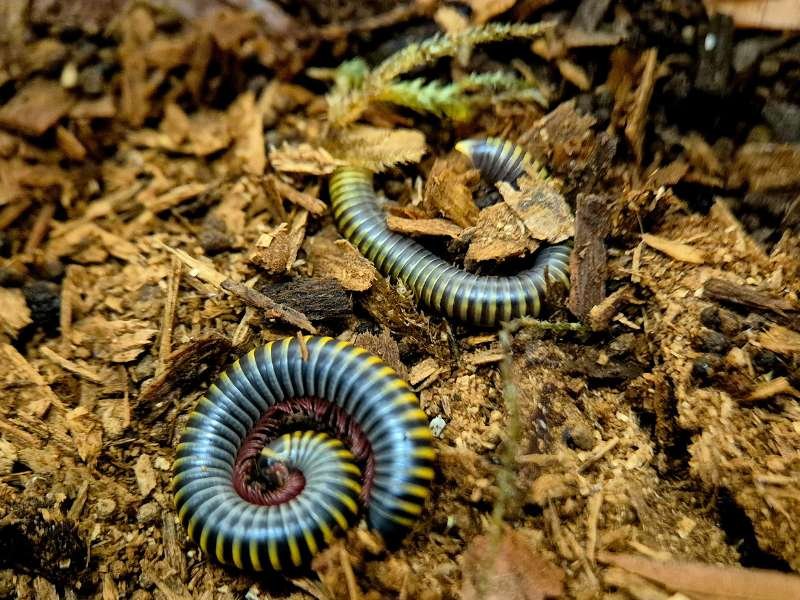
Anadenobolus monilicornis ‘Bumble Bee Millipede’
£6.00
Scientific Name: Anadenobolus monilicornis
Common Name: Bumble Bee Millipede
Anadenobolus monilicornis ‘Bumble Bee Millipede’ is a striking tropical species with bold black and yellow banding. Furthermore, it is active, hardy, and easy to keep.
🐝 Bold Black and Yellow Banding | 🌿 Active Display Species | ♻️ Captive Bred
Description
Scientific Name: Anadenobolus monilicornis
Common Name: Bumble Bee Millipede
Native Habitat
Anadenobolus monilicornis inhabits tropical forests throughout parts of the Caribbean, where it lives amongst leaf litter, decaying wood, and organic debris.
These habitats provide food, shelter, and ideal breeding conditions. Consequently, this species thrives within humid woodland ecosystems rich in decomposing organic matter.
Furthermore, deep layers of leaf litter and rotten wood provide essential nutrition throughout its life cycle. Therefore, similar conditions should be recreated in captivity.
Care Information
Anadenobolus monilicornis ‘Bumble Bee Millipede’ is a striking tropical species admired for its bold black and yellow banding. Its vibrant colouration immediately attracts attention within naturalistic enclosures.
Furthermore, its active nature makes it particularly rewarding to observe. As a result, it has become one of the most popular millipede species in the hobby.
Unlike some more secretive species, Bumble Bee Millipedes frequently explore the enclosure surface. Consequently, there is often something interesting to watch.
Its manageable size, attractive appearance, and straightforward care requirements create broad appeal. Therefore, it is suitable for both beginners and experienced keepers.
Temperature: 22-27°C
Humidity: Moderate to high humidity with good ventilation
Diet: Leaf litter, rotten wood, vegetables, mushrooms, and other decaying organic matter
Difficulty: Easy
Provide a deep substrate rich in decayed hardwood, white rotten wood, and leaf litter. Additionally, include cork bark and moss to create natural hiding places.
Maintain a slightly moist substrate while avoiding waterlogged conditions. Meanwhile, ensure adequate ventilation throughout the enclosure.
Leaf litter and decomposing wood should always be available. Consequently, essential nutrition remains accessible throughout the animal’s life.
A constant calcium source is equally important. Therefore, provide cuttlebone, limestone, or crushed oyster shell to support healthy growth and moulting.
Breeding Information
Under suitable conditions, Bumble Bee Millipedes breed readily in captivity. Consequently, healthy colonies can establish successfully over time.
Females deposit eggs within the substrate, where juveniles develop amongst decaying organic material. Furthermore, young millipedes gradually mature through a series of moults.
Stable temperatures, adequate moisture, and nutrient-rich substrate encourage successful reproduction. As a result, breeding projects can be both productive and rewarding.
Captive-Bred Details
All specimens are captive bred. Therefore, they adapt exceptionally well to enclosure life.
Captive-bred Bumble Bee Millipedes settle quickly into new environments. Furthermore, they perform exceptionally well in both dedicated millipede enclosures and bioactive setups.
Their vibrant colouration, active behaviour, and ease of care create outstanding appeal. As a result, they remain one of the most rewarding tropical millipede species available.
Whether maintained as a display animal or breeding colony, this species performs exceptionally well. Ultimately, Anadenobolus monilicornis combines beauty, activity, and simplicity in one impressive package.
🐝 Bold Black and Yellow Banding | 🌿 Active Display Species | ♻️ Captive Bred
Reviews
There are no reviews yet.