
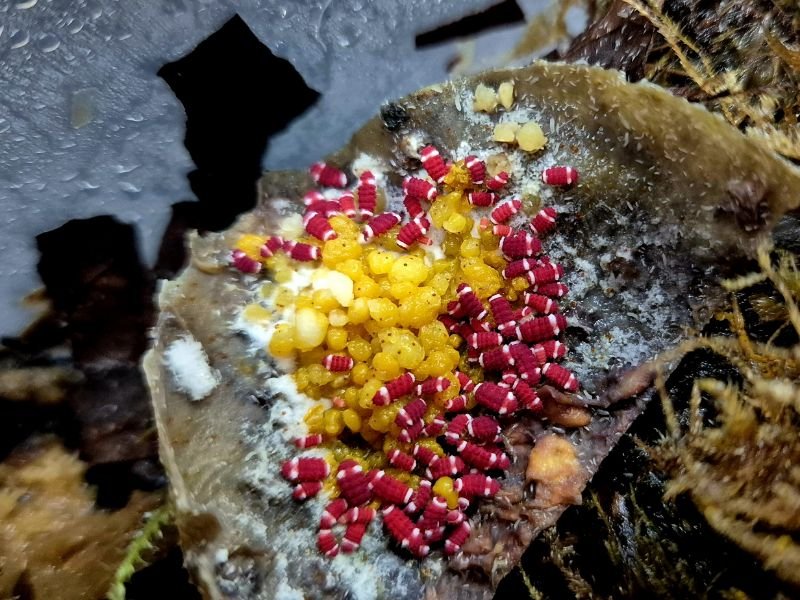
Neanuridae sp. Redford White ‘Santa claus springtails’
Price range: £50.00 through £90.00
Scientific Name: Neanuridae sp. Redford White
Common Name: Santa Claus Springtail
Neanuridae sp. ‘Redford White’ is a striking tropical springtail with deep red colouration and contrasting creamy-white markings. Larger and slower-moving than many common springtails, they are easy to observe and make an excellent addition to humid bioactive setups or specialist springtail collections.
Captive-bred • Striking red and white colouration • Larger springtail • Humid bioactive species • Specialist clean-up crew
Description
Scientific Name: Neanuridae sp. Redford White
Common Name: Santa Claus Springtail
Neanuridae sp. ‘Redford White’, commonly known as the Santa Claus Springtail, is a striking tropical springtail with deep red colouration and contrasting creamy-white markings. Their unusual pattern gives them a completely different appearance from the tiny white springtails commonly used in bioactive enclosures.
Adults reach around 4–5 mm, making them noticeably larger and easier to observe than many standard springtail species. They also move relatively slowly across moss, bark and substrate, which makes established colonies particularly enjoyable to watch.
Native Habitat
Santa Claus Springtails favour very humid microhabitats containing plenty of decomposing organic material. Damp leaf litter, moss, rotten wood and fungal growth provide both shelter and a constant supply of microscopic food.
Their captive enclosure should recreate these conditions with consistent moisture and plenty of natural structure. Moss, decomposing hardwood and leaf litter all help maintain humidity while giving the colony useful grazing surfaces.
Care Information
Adult Size: Around 4–5 mm
Temperature: Around 18–25°C
Humidity: High
Diet: Fungal growth, slime mould and soft organic foods
Difficulty: Intermediate
Activity: Slow-moving
A small plastic culture tub works particularly well for Santa Claus Springtails. They do not need a large enclosure, but they require stable humidity and access to consistently moist areas.
Use a secure lid with enough ventilation to prevent stagnant conditions without allowing the culture to dry too quickly. These springtails depend heavily on moisture, so stability matters more than constantly changing between wet and dry conditions.
Substrate
Use a moisture-retentive organic substrate containing materials such as organic soil, coco coir, leaf mould and decomposed hardwood. Moss also works extremely well because it holds moisture while creating plenty of surface area for adults and juveniles.
Add small pieces of rotten hardwood and leaf litter across the surface. These materials encourage natural fungal growth and provide sheltered spaces throughout the culture.
Moisture and Humidity
Keep the substrate consistently damp but never flooded. Moss can act as a useful moisture reservoir and helps create protected humid pockets throughout the enclosure.
Avoid allowing the culture to dry completely, as springtails lose moisture quickly. Light misting whenever the upper layers begin to dry usually works better than soaking the enclosure irregularly.
Feeding
Neanuridae sp. ‘Redford White’ feeds heavily on slime mould. It is advisable to practice culturing slime mould prior to getting your springtails.
Natural fungal growth should form an important part of the culture rather than trying to keep the enclosure completely sterile. A healthy springtail setup should behave more like a miniature decomposer ecosystem than a spotless plastic box.
Behaviour
Santa Claus Springtails behave quite differently from the familiar white springtails used in many bioactive setups. They move slowly across surfaces and remain visible for longer, making them much easier to appreciate as animals in their own right.
Their larger size and bright red-and-white pattern also make them excellent display springtails. Established colonies often gather around fungal growth, moss and feeding areas, where several individuals may remain visible at once.
Bioactive and Clean-Up Crew Use
Santa Claus Springtails can work as part of a clean-up crew in warm, consistently humid enclosures. They graze on fungal growth, soft organic debris and mould.
They can live alongside compatible tropical isopods, millipedes and other moisture-loving invertebrates. However, they generally reproduce more slowly than common white springtails, so they work best as a secondary clean-up species rather than the only springtail in a large enclosure.
Their bright colour gives them another advantage in display setups. Unlike many traditional springtails, these are clean-up crew members you may actually notice.
Breeding Information
Neanuridae sp. ‘Redford White’ can build healthy captive populations when conditions remain stable. Consistent moisture, fungal growth and a steady supply of slime mould, adults and juveniles to thrive.
You do not need to separate generations. Young springtails remain within the same substrate and naturally use the tiny humid spaces between moss, wood and organic material.
Encouraging Strong Colonies
Avoid repeatedly disturbing the enclosure or replacing the entire substrate. Eggs and very young springtails can easily disappear within the substrate, while established fungal growth forms an important part of their food supply. Always make sure there is slime mould for them to eat.
Instead, refresh the culture gradually by adding new moss, leaf litter and decomposed wood when required. Once the population becomes strong, you can divide part of the colony into another container to create a backup culture.
Colony Maintenance
Once established, Santa Claus Springtails require relatively little routine maintenance. Keep the culture moist, provide suitable food and remove anything that begins to rot excessively.
Avoid overfeeding, as large amounts of uneaten food can encourage mites and unwanted mould. Small, regular amounts usually work much better.
Maintaining a second culture is worthwhile with unusual springtails. It gives you a backup population while also allowing you to harvest animals for bioactive setups without heavily reducing the main breeding colony.
Captive-Bred Details
Our Neanuridae sp. ‘Redford White’ Santa Claus Springtails come from captive-bred cultures. Maintaining strong captive populations helps keep unusual springtails established within the hobby while reducing unnecessary reliance on wild collection.
Their larger size, slow movement and bold red-and-white colouration make them one of the most distinctive springtails available. They work well as a specialist clean-up species, but they are equally rewarding simply as a fascinating microfauna culture.
Tiny decomposer, festive paint job!
Captive-Bred by NaturesZion
Additional information
| Amount | 10, 20 |
|---|
Reviews
There are no reviews yet.